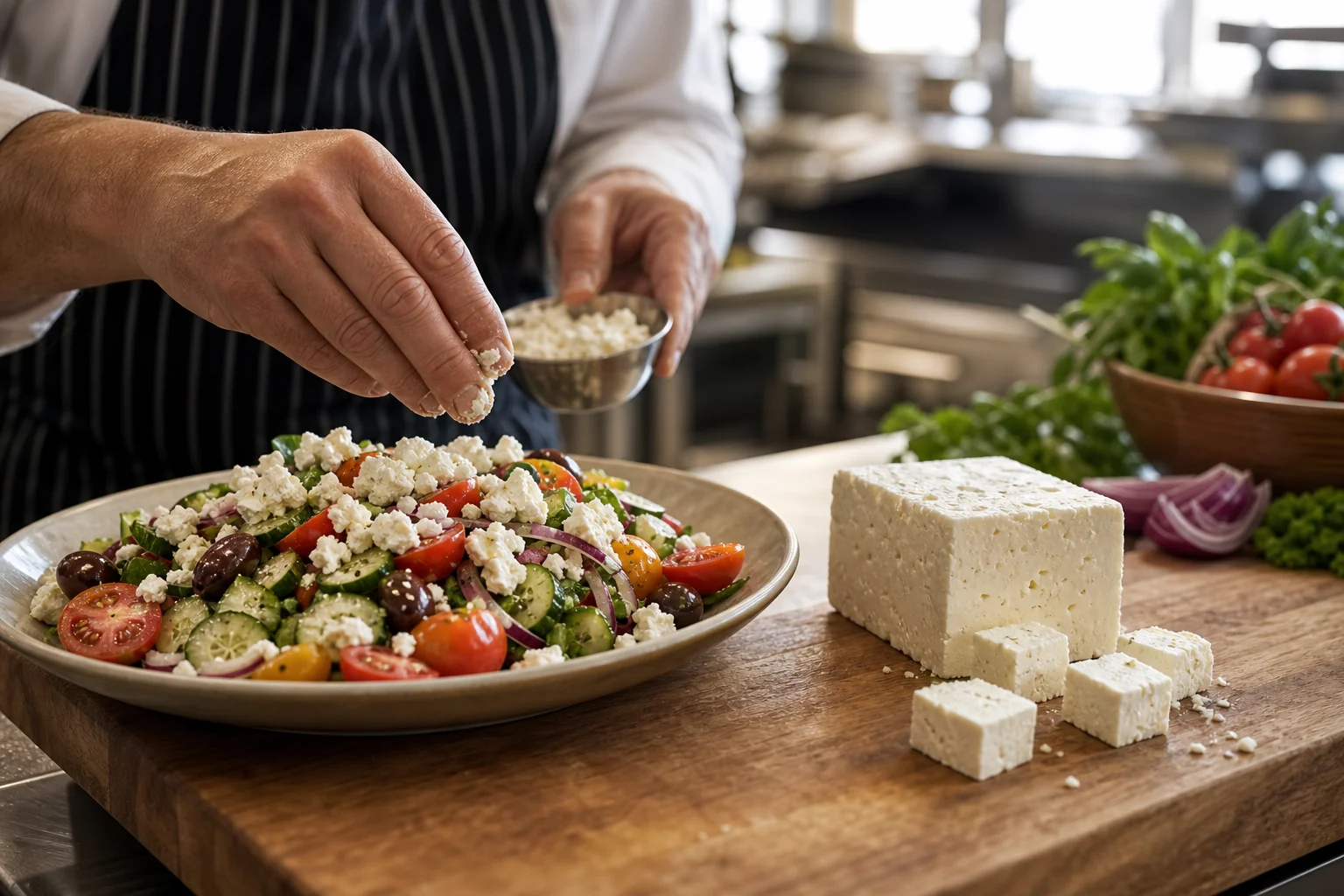
Feta is one of the most versatile and dependable cheeses in any commercial kitchen. Whether you run a high-volume Greek restaurant, a fast-casual salad bar, a catering operation, or an institutional dining program, feta earns its place on the line by performing well across dozens of applications — from cold salads and grain bowls to baked appetizers, flatbreads, and whipped dips. Demand for Mediterranean-inspired dishes has continued to grow across Canadian menus, and with it, the range of feta products available through foodservice distributors has expanded considerably.
This guide covers five feta products from the Foodex catalogue so buyers can compare brands, formats, milk types, and wholesale listings in one place. It also covers what makes a good feta for commercial use, how to choose between block and pre-crumbled formats, how packaging affects quality and storage, and what questions to ask your supplier before placing an order.
What Makes a Good Feta Cheese for Restaurants?
Not all feta performs equally in a commercial kitchen. When evaluating a feta for food service, the qualities that matter most are slightly different from what you might look for at a retail counter.
Flavour is the first consideration. The spectrum runs from mild and lightly tangy on one end — typical of cow's-milk feta — to sharp, salty, and complex on the other, as found in authentic PDO sheep's-milk feta aged in brine. For most restaurant applications, a moderate balance of saltiness, acidity, and dairy depth works best, since feta is usually one component of a larger dish rather than the centrepiece.
Texture matters enormously for operational consistency. Feta that crumbles cleanly over a salad behaves very differently from a softer, creamier style that spreads easily into a dip. A block that holds its shape when sliced or cubed is essential for composed plates, while a slightly softer texture blends more smoothly when whipped. Understanding the intended application before selecting a format saves time and reduces waste.
Ability to hold shape in heat separates workhorses from specialty products. Feta that firms up and browns when baked or pan-fried — rather than melting away — is ideal for saganaki, baked appetizers, and stuffed proteins. Not every feta behaves the same way under heat, and testing before committing to a case order is worthwhile.
Consistency between cases is often underestimated as a quality criterion. In a high-volume kitchen, you need to know that the feta arriving on Tuesday performs the same way as the case that arrived three weeks ago. Major Canadian dairy cooperatives and well-established importers generally provide better lot-to-lot consistency than smaller artisan suppliers.
Ingredient quality and milk type shape the flavour foundation. Sheep's milk produces a richer, more complex, slightly gamey feta. Goat's milk adds brightness and tang. Cow's milk yields a milder, creamier result with less pronounced flavour. Blends of two or three milk types fall somewhere in between. For restaurants positioning themselves as authentic Greek or Mediterranean operations, the milk type carries marketing value as well as culinary consequence.
Cost per serving is the practical constraint. Authentic PDO feta imported from Greece carries a premium over domestically produced cow's-milk feta-style cheese, sometimes two to three times the cost per kilogram. The right choice depends on how visible feta is on your menu and how much per-serving food cost your margins can absorb.
Shelf life and storage affect purchasing rhythm. Brined feta typically lasts longer once opened and retains moisture and flavour better than dry-packed. Pre-crumbled formats, while convenient, often have a shorter open-shelf life and may dry out faster in a reach-in cooler.
Distributor availability is the final practical check. The best feta in the world is not useful if it requires a three-week lead time or a minimum order your operation cannot absorb.
Types of Feta You May Encounter
Canadian buyers typically encounter several distinct categories of feta-style cheese, and understanding the differences helps narrow the field quickly.
Traditional Greek PDO feta is the protected standard. Under European Union regulation, only feta produced in specific regions of Greece — primarily Macedonia, Thrace, Epirus, Thessaly, central Greece, the Peloponnese, and Lesbos — using sheep's milk or a blend of sheep's milk with up to 30 percent goat's milk may carry the PDO designation. It must be aged for at least 60 days and packed in brine. The flavour is typically robust, tangy, and salty, with a firm yet crumbly texture that softens over time in brine. This is the gold standard for Greek restaurants and any operation where authenticity is a selling point.
Sheep's-milk feta produced outside Greece follows similar processes but cannot carry the PDO label. Flavour profiles are comparable but may vary depending on the producer and the milk source.
Sheep-and-goat-milk blends approximate the PDO style and are common among importers serving the North American market. These offer a reasonable balance of flavour complexity and price.
Cow's-milk feta-style cheese is by far the most common product in Canadian foodservice. It is produced domestically by major dairy cooperatives including Saputo, Agropur, and Lactalis Canada. Flavour is milder and less complex than sheep's-milk variants, but the lower cost, consistent availability, and good performance across a wide range of applications make it the workhorse of Canadian commercial kitchens.
Bulgarian-style white brined cheese is made from sheep's milk and has a creamier, less crumbly texture than Greek PDO feta. It sees limited distribution in Canada but appears occasionally in Eastern European delis and specialty importers.
French-style feta tends to be creamier and milder than its Greek counterpart, made from sheep's or cow's milk depending on the producer. It performs well in dips and spreads.
Reduced-fat feta removes some of the milkfat to appeal to health-conscious diners. Texture and flavour suffer noticeably, and it performs less consistently under heat. It is rarely the preferred choice for cooking applications, though it can work in cold salad formats.
How These Five Products Were Selected
The products in this guide were drawn from the Foodex catalogue and evaluated against the following criteria.
| Criterion | What was evaluated |
|---|---|
| Taste | Balance of saltiness, acidity, and dairy flavour |
| Texture | Creaminess, crumbliness, firmness, and heat performance |
| Versatility | Performance across salads, sauces, baking, and toppings |
| Value | Cost relative to quality, usable yield, and pack efficiency |
| Consistency | Reliability from package to package |
| Availability | Ease of ordering in foodservice quantities across Canada |
The five selections represent different points on the spectrum of price, milk type, format, and intended use case, so buyers can identify the best fit for their specific operation rather than receiving a single blanket recommendation.
Product Profiles
1. Krinos Greek Feta PDO
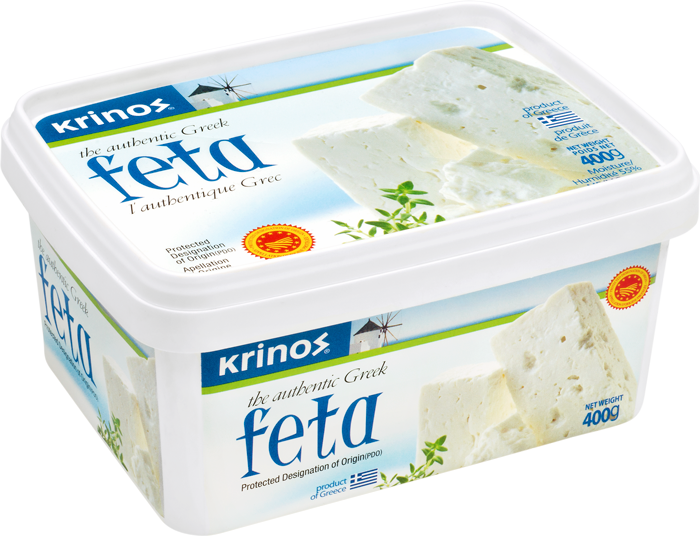
View Krinos Greek Feta PDO on Foodex
| Detail | Information |
|---|---|
| Producer | Krinos Foods Canada |
| Country / Region | Greece — Epirus region |
| Pack size | 2 kg |
| Milk type | Sheep's milk and goat's milk (PDO blend) |
| Packaging | Brined block |
| Salt level | High |
| Flavour profile | Rich, tangy, and distinctly sharp with pronounced dairy depth |
| Texture | Firm and crumbly; softens gradually in brine over time |
About this product. Produced in the northern region of Epirus, Krinos Greek Feta has been imported into Canada for over 50 years and is known for the high-quality milk and local traditional cheesemaking methods used in its production. It is aged for a minimum of 60 days, giving it a distinct and rich taste celebrated for its versatility. It is gluten-free, contains no sulphites, and is a good source of calcium and protein. It is made from 100 percent pasteurized sheep's and goat's milk, salt, bacterial cultures, and enzymes, packed in brine.
The PDO designation matters here. Under European Union Protected Designation of Origin rules introduced in 1992, every part of the production, processing, and preparation process must take place in the specific designated region of Greece for a product to carry the PDO label. For restaurants that want to communicate authenticity to their guests — on menus, through staff, or in marketing — this is the only product in this guide that can legitimately make that claim.
Best restaurant applications. Greek salad, spanakopita, saganaki, mezze boards, baked feta appetizers, watermelon and feta salad, grain bowls where authenticity is a menu point.
Advantages. Authentic PDO status; complex, distinctive flavour; works well as a finishing cheese and in brine-cured preparations; strong brand recognition with staff and diners familiar with Greek food.
Potential drawbacks. The 2 kg format is on the smaller end for high-volume operations and may require more frequent ordering. Cost per kilogram is higher than domestically produced alternatives. The bold flavour may overpower delicate preparations.
Best suited for. Greek and Mediterranean restaurants, upscale casual dining, chef-driven menus where provenance is a selling point, catering operations serving Greek community events.
2. Agropur Solutions AFS Feta Cheese Block 4.1 kg
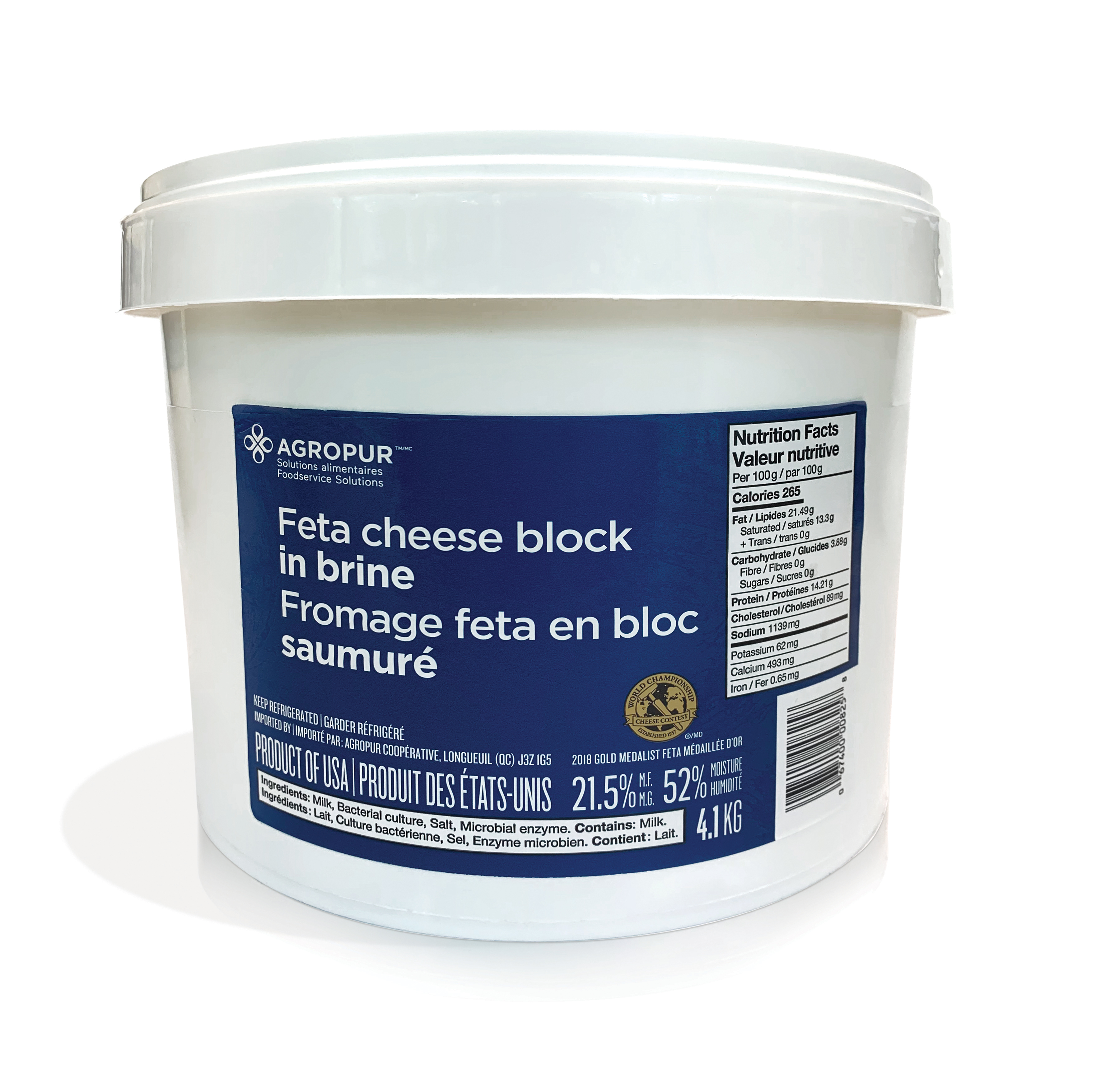
View Agropur Solutions AFS Feta Cheese Block on Foodex
| Detail | Information |
|---|---|
| Producer | Agropur Cooperative |
| Country / Region | Canada |
| Pack size | 4.1 kg |
| Milk type | Cow's milk |
| Packaging | Block (brined) |
| Salt level | Moderate to robust |
| Flavour profile | Clean, robust, and versatile with good balance of salt and mild tang |
| Texture | Firm and crumbly with a creamy white appearance |
About this product. The AFS Feta Cheese Block offers a firm, crumbly texture and robust flavour, making it ideal for both sweet and savoury recipes. It is produced with milk, bacterial culture, salt, and microbial enzyme. Agropur is one of North America's leading dairy processors, and its award-winning, all-natural cheeses are produced for foodservice, industrial applications, and global export. The cooperative was founded in 1938 in Granby, Quebec, and is now headquartered in Saint-Hubert, Quebec, with revenues of C$7.3 billion as of 2021 and a workforce of around 7,500 employees.
The 4.1 kg block is available through at least one major Quebec foodservice distributor, Aubut, where it is listed as a brined feta cheese block. The larger pack size makes this a strong fit for kitchens that go through feta quickly and want to minimize packaging waste and per-case handling.
Best restaurant applications. Salads, grain bowls, flatbreads, pasta, omelettes, stuffed proteins, pizza toppings, whipped feta dip. The block format allows the kitchen to cut it to specification — cubed for composed salads, sliced for baking, or crumbled to order.
Advantages. Large pack size supports high-volume throughput; domestic production means consistent availability and shorter supply chains; Agropur's scale as a cooperative provides reliable lot-to-lot consistency; robust flavour performs well in cooked applications.
Potential drawbacks. Cow's milk base lacks the complexity of sheep's-milk feta; not a PDO product, so it cannot be marketed as authentic Greek feta; buyers need to confirm brine inclusion when ordering.
Best suited for. High-volume casual dining, QSR salad programs, institutional kitchens, catering companies that serve feta at scale and need a dependable, cost-effective block format.
3. Lactalis Président Professionnel Feta Cheese Crumbled (2 × 2.3 kg)
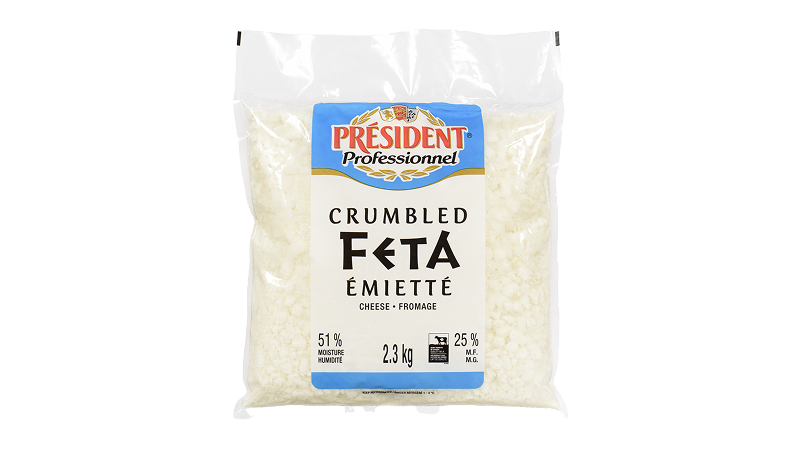
View Lactalis Président Professionnel Feta Cheese Crumbled on Foodex
| Detail | Information |
|---|---|
| Producer | Lactalis Canada (Président Professionnel brand) |
| Country / Region | Canada |
| Pack size | 2 × 2.3 kg (4.6 kg total) |
| Milk type | Cow's milk (pasteurized) |
| Packaging | Pre-crumbled, dry-packed |
| Milk fat | 25% m.f. |
| Moisture | 51% |
| Salt level | Moderate |
| Flavour profile | Fresh, mild, and clean with a light tang |
| Texture | Soft crumbles; slightly moist |
About this product. The Président Professionnel Crumbled Feta is positioned as a fresher, milder alternative to traditional brine-aged feta — a deliberate design choice for kitchens serving guests who find sharp feta too assertive. It is produced from fresh, high-quality pasteurized milk at 25 percent milkfat and 51 percent moisture, giving it a softer texture that integrates easily into cold applications. Président Feta is trusted by professional chefs and restaurant industry leaders for its authentic taste and consistent performance, with users noting that the clean taste and authentic look of the crumbles provide confidence in the product they are serving their guests, while the affordable price represents a strong value proposition.
Lactalis Canada Foodservice is the exclusive national dairy partner of the Canadian Culinary Federation and received the 2022 Supplier of the Year Pinnacle Award from Foodservice and Hospitality magazine. The Président Professionnel line is specifically designed for foodservice operations, with formats and packaging calibrated for commercial kitchens rather than retail consumers.
The dual-bag format (2 × 2.3 kg) offers a practical split: one bag can be opened and kept in service while the second remains sealed and refrigerated, extending overall freshness.
Best restaurant applications. Salad stations, grain bowls, flatbreads, shakshuka, omelettes, breakfast wraps, whipped feta dip, Mediterranean sauces. Président Professionnel crumbled feta blends smoothly into a whipped feta dip when combined with Greek yogurt, olive oil, lemon juice, minced garlic, and black pepper in a food processor. The mild flavour profile makes it particularly well suited to dishes where feta plays a supporting role rather than the lead.
Advantages. No prep required — the crumbles are ready to portion directly from the bag; the mild flavour appeals to a broader range of guests; consistent crumble size improves portion accuracy on high-volume salad lines; dual-bag format reduces waste from opened product; strong distributor support through Lactalis Canada's national network.
Potential drawbacks. Pre-crumbled feta cannot be cubed, sliced, or whipped from a block texture; the drier format is less suited to applications where brined moisture matters; mild flavour may disappoint diners expecting traditional Greek feta sharpness.
Best suited for. Fast-casual restaurants with high salad volume, pizza chains, catering operations needing ready-to-use crumbles, institutional kitchens with limited prep labour, operations building a whipped feta program.
4. Saputo Feta — 1 × 12 kg Block

| Detail | Information |
|---|---|
| Producer | Saputo Inc. |
| Country / Region | Canada |
| Pack size | 1 × 12 kg block |
| Milk type | Cow's milk |
| Packaging | Block, packed in brine |
| Salt level | Moderate to robust |
| Flavour profile | Fresh, salty, with a slightly tangy finish |
| Texture | Soft, crumbly, and moist |
About this product. Saputo's cow's-milk feta is fresh yet salty with a slightly tangy taste, and its soft, crumbly texture makes it suited to a wide range of culinary creations. The 12 kg block format is the largest in this guide and is specifically designed for operations that process feta at high volume and want maximum flexibility over how the cheese is cut, crumbled, or portioned.
Saputo Foodservice is proud to offer products manufactured in Canada using milk from Canadian farms, making no compromise on taste or quality. Saputo notes that its feta helps chefs streamline prep, reduce waste, and enhance presentation while delivering bold, balanced flavour. Its clean white colour and creamy texture add contrast and visual appeal, while its saltiness brings depth to both hot and cold dishes.
Saputo also offers a wider feta ecosystem than any other producer in this guide, including cow's milk, goat milk, mixed milk, and lactose-free feta variants, as well as flavoured feta with herbs and sundried tomatoes, giving buyers options to extend or diversify a feta program without switching suppliers. The standard 12 kg block is the anchor of that line for bulk buyers.
Best restaurant applications. Pizza, salads, omelettes, flatbreads, feta fries, baked feta starters, pasta. Saputo suggests uses for feta including grill, fry, and bake applications, as well as globally inspired dishes and even cocktail garnishes. The large block gives the kitchen full control over cut and crumble size for any of these formats.
Advantages. Largest pack size in this guide, reducing per-kilogram cost and purchasing frequency; produced from Canadian milk with strong national distributor network; consistent quality from one of Canada's largest dairy producers; the brine pack retains moisture and flavour better than dry pre-crumbled formats; flexibility to cut, cube, crumble, or whip.
Potential drawbacks. A 12 kg block requires confident volume to use before quality degrades after opening; handling a block this size requires proper storage setup, including a container large enough to keep unused portions submerged in brine; the mild cow's-milk base is not appropriate for operations requiring PDO authenticity.
Best suited for. High-volume restaurants and chains, pizza operations, large catering companies, ghost kitchen operators with multiple menu applications for feta, institutional buyers such as university food services or hospital dining programs.
5. Skotidakis Diced Feta Cheese — 200 g

View Skotidakis Diced Feta Cheese on Foodex
| Detail | Information |
|---|---|
| Producer | Skotidakis |
| Country / Region | St. Eugene, Ontario, Canada |
| Pack size | 200 g |
| Milk type | Cow's and goat's milk blend |
| Packaging | Diced, packed in brine |
| Salt level | Moderate — described as "perfectly balanced, not too salty" |
| Flavour profile | Fresh, lightly tangy, clean, with mild goat's-milk complexity |
| Texture | Firm dice; holds shape well |
About this product. Skotidakis Diced Feta is made from pasteurized cow's and goat's milk and is designed to be sprinkled directly onto dishes with no prep required. Skotidakis is located in St. Eugene, Ontario, where founder Peter Skotidakis purchased the farm in 1975 with the dream of creating and distributing his own version of traditional Greek feta cheese. Starting with a herd of only 20 goats, he introduced his feta and yogurt to local markets and restaurants in Montreal, and the products' success allowed the operation to grow to more than 3,000 goats on a 1,500-acre farm.
The blend of cow's and goat's milk yields a feta that is perfectly balanced and not too salty, with ingredients including pasteurized cow's and goat's milk, milk protein concentrate, bacterial cultures, calcium chloride, microbial enzyme, and salt, packaged in brine. The goat's-milk contribution gives this product a flavour lift above a pure cow's-milk feta without reaching the intensity of full sheep's-milk PDO feta — a middle-ground option that suits menus targeting a broad audience.
Skotidakis supplies feta in blocks, diced, and crumbled formats to food manufacturing and catering companies across Canada and the United States, operating a 130,000-square-foot production facility that enables industrial quantities without compromising quality.
The 200 g retail-oriented format listed on Foodex is unusual in this group of foodservice products. Buyers who need larger volumes should contact Skotidakis directly about foodservice pack sizes, which include larger blocks and crumbled formats available to distributors and institutional buyers.
Best restaurant applications. Salad garnish, grain bowls, grain bars, breakfast stations, single-serve charcuterie or mezze plates, portable catering setups where pre-diced cheese reduces prep time.
Advantages. The cow-and-goat-milk blend offers more flavour complexity than a pure cow's-milk product at a more accessible price than sheep's-milk PDO feta; the pre-diced format eliminates knife prep entirely; Canadian-made with an authentic goat-farming story that has some marketing value; balanced salt level reduces the risk of over-seasoning a dish.
Potential drawbacks. The 200 g pack is small for high-volume foodservice and may not be the most cost-efficient format for kitchens using feta at scale — confirming foodservice pack availability directly with the supplier is advisable; not a PDO product.
Best suited for. Cafés, delis, boutique catering operations, food trucks, salad bars with lower weekly feta volume, school or workplace cafeterias looking for a Canadian-sourced product with a differentiated flavour profile.
Best Feta by Restaurant Use Case
Rather than ranking these five products one through five, the following designations reflect the most practical fit for each operational context.
Best overall: Saputo Feta 12 kg Block. The largest format, broadest distributor network, brine pack for moisture retention, and reliable consistency from one of Canada's largest dairy producers make this the default workhorse for most commercial kitchens.
Best authentic Greek feta: Krinos Greek Feta PDO. The only PDO-certified product in this guide. If your menu makes a provenance claim about authentic Greek feta, this is the one to use.
Best value for high-volume restaurants: Agropur AFS Feta Block 4.1 kg. A large, cost-effective block from a major Canadian cooperative with reliable availability and a robust flavour that holds up well in cooked applications.
Best for salads and ready-to-use applications: Lactalis Président Professionnel Crumbled 2 × 2.3 kg. No prep, consistent crumble size, mild flavour that appeals to a broad audience, and a dual-bag format that supports freshness management on a salad line.
Best for baking and hot dishes: Saputo Feta 12 kg Block or Agropur AFS Feta Block 4.1 kg. Both hold their shape well under heat and can be sliced or cubed before baking. The Krinos PDO also performs well in baked applications but at a higher cost per serving.
Best for dips and whipped feta: Lactalis Président Professionnel Crumbled. The softer, fresher texture blends smoothly into a food processor. For a more intense whipped feta, the Agropur block provides a firmer base that may produce a slightly thicker result.
Best premium option for chef-driven menus: Krinos Greek Feta PDO. The combination of authentic provenance, complex flavour, and recognized brand name supports premium menu positioning.
Best flavour complexity at a mid-range price: Skotidakis Diced Feta. The cow-and-goat-milk blend punches above its price point in terms of flavour and has a Canadian farm story worth mentioning.
Block Feta Versus Pre-Crumbled Feta
The decision between block and pre-crumbled feta is primarily an operational one, and the right answer depends on labour availability, volume, and application.
Block feta generally delivers superior freshness and flavour because the outer surface of the cheese is protected until the moment it is needed. It retains moisture in the brine and can be handled in multiple ways: sliced for baked dishes, cubed for composed salads, crumbled to order, or whipped in a food processor. Of the five products in this guide, Krinos PDO, Agropur AFS, and Saputo all come in block format. The trade-off is labour: someone in the kitchen needs to portion the block before service, and opened blocks need to be properly submerged and stored.
Pre-crumbled feta like the Lactalis Président Professionnel and the Skotidakis Diced format eliminates that prep step entirely. On a busy salad line or in a high-throughput kitchen, the time saved across a service period is real. Pre-crumbled products also make portion control easier because the crumbles can be measured by weight or scoop without additional processing. The drawbacks are that dry-crumbled feta dries out faster once opened, may contain small amounts of anti-caking ingredients to prevent clumping, and cannot be repurposed as easily into other formats like cubes or whipped feta.
For most operations, the pragmatic answer is to carry one block format for versatility and one pre-crumbled format for speed, using each where it fits best.
Feta Packed in Brine Versus Dry-Packed
Brine-packed feta and dry-packed feta behave differently from the moment they arrive in your kitchen, and the distinction matters for quality, storage, and application.
Brine-packed feta — including the Krinos PDO, Agropur AFS block, and the Saputo 12 kg block — keeps the cheese submerged in a salted liquid that maintains moisture, preserves the cheese, and continues to develop flavour during storage. Once a block is opened, unused portions should be returned to the brine or transferred to a container with enough brine to keep the surface covered. Brine-packed feta generally has a longer open-shelf life, stays creamier, and crumbles with more moisture in the finished product, which matters in applications like whipped feta where a dry texture would be noticeable.
Dry-packed feta, which includes most pre-crumbled products, is ready to use without draining and is more convenient for direct portioning. However, it dries out faster once opened and has less tolerance for temperature fluctuations during storage. If a bag of pre-crumbled feta sits partially used in a reach-in for several days, the edges may develop a dry, slightly rubbery texture that affects the eating experience. Rotation discipline and clear labelling with opening dates are especially important with dry-packed formats.
For applications where the moisture content of the feta matters — whipped feta, sauces, baked dishes where you want the cheese to remain creamy rather than dry out — brine-packed blocks are the better choice. For applications where you want clean, dry crumbles that do not add liquid to a salad or grain bowl, dry-packed pre-crumbled feta has a functional advantage.
Menu Applications Beyond Greek Salad
Feta earns its place on a menu by appearing in more than one dish. Buyers who are committed to a single pack format can realize much better value by finding multiple uses for the same product. Here are applications worth considering across dayparts and cuisine types.
Whipped feta dip. One of the fastest-growing feta applications on Canadian menus. Blended with Greek yogurt, olive oil, lemon juice, and garlic, whipped feta creates a versatile spread that works as an appetizer with pita, a sauce base for grain bowls, or a condiment for burgers and sandwiches. The Président Professionnel Crumbled blends easily and the Agropur block produces a slightly denser, richer result.
Flatbreads and pizzas. Feta crumbles or slices placed on a flatbread before or after baking add salt, creaminess, and visual contrast. It pairs particularly well with roasted vegetables, olives, lamb, and herbs. Saputo's 12 kg block or the Agropur 4.1 kg block make sense for pizza operations given the volume required.
Burgers and sandwiches. A smear of whipped feta on a burger bun, or crumbled feta added to a wrap alongside grilled chicken and roasted peppers, lifts a familiar format without requiring a menu overhaul.
Grain bowls. Feta is a natural grain bowl topping, adding protein, salt, and creaminess to quinoa, farro, barley, or rice bases. Pre-crumbled formats shine here for their portioning efficiency.
Roasted vegetables. Feta crumbled over roasted beets, sweet potatoes, cauliflower, or carrots just before serving adds a salty contrast to the natural sweetness of the vegetable. Brined feta is preferred here so the moisture integrates with the dish.
Pasta dishes. Feta melted into a tomato or spinach pasta sauce adds body and salt. Whole blocks of feta baked in a roasting pan surrounded by cherry tomatoes — a technique that achieved significant viral reach in recent years — produce a creamy sauce that became a legitimate addition to many restaurant menus.
Omelettes and breakfast wraps. Feta in breakfast applications has become mainstream across Canadian brunch menus. It pairs particularly well with spinach, sun-dried tomatoes, and roasted peppers, and the Skotidakis diced format reduces prep time in a busy breakfast kitchen.
Feta fries. Thick-cut fries topped with crumbled feta, lemon zest, and herbs have appeared on Greek-inspired menus as a shareable side. Simple, high-margin, and visually striking.
Baked feta appetizers. A block of feta baked in olive oil with herbs and honey makes an impressive table starter with minimal preparation. The Krinos PDO performs particularly well here because its firmer texture and more complex flavour reward the simplicity of the preparation.
Mediterranean sauces. Feta can be blended into creamy dressings, vinaigrettes, and sauces that work across salads, grains, and proteins. A simple feta-lemon-olive oil dressing requires only a blender and a few minutes.
Watermelon and feta salad. A summer menu staple that needs no recipe explanation. The contrast of sweet, crisp watermelon against salty, creamy feta has real seasonal appeal, and the Krinos PDO or Skotidakis diced format works well here.
Feta-stuffed proteins. Chicken breasts, lamb chops, or pork tenderloin stuffed with feta and herbs create an impressive plated entrée with relatively low preparation complexity.
Cost and Portioning
Understanding the food cost per serving begins with the purchase price per kilogram, but usable yield and serving size are equally important. The following estimates are provided as a starting framework; actual food costs will vary based on your supplier pricing, regional availability, and negotiated volume discounts.
Salad garnish (20–30 g per serving). A 30-gram portion from a 4.1 kg block that costs approximately $55 per case works out to roughly 137 portions per case, before accounting for any trim or crumble waste. At a cost of approximately $0.40 per portion, feta is an economical flavour addition to a salad.
Grain bowl or entrée topping (30–45 g per serving). At 40 grams per portion, the same 4.1 kg block yields approximately 100 portions. The cheese cost per bowl item remains modest even at this serving size.
Whipped feta appetizer (60–90 g per order). At 75 grams of feta per whipped dip portion, usable portions per block drop considerably. However, the labour added during preparation and the selling price of the appetizer typically offset the higher cheese cost per order.
For the pre-crumbled formats, there is generally less trim waste but a higher purchase price per kilogram compared to block formats from the same manufacturer. For high-volume operations with limited prep labour, the trade-off often favours the pre-crumbled product even at a slight cost premium.
Storage and Waste Reduction
Feta handles well when stored correctly, but it deteriorates quickly when it does not. A few operational habits make a meaningful difference in both quality and cost.
Keep brine-packed feta submerged. Once a block has been partially used, the remaining cheese should go into a clean container with enough brine — or a fresh brine made from salted water — to keep it fully covered. Exposed surfaces dry out and develop an unpleasant chalky texture within a day or two.
Use clean, dry utensils every time. Contaminating the brine with food residue or kitchen debris accelerates spoilage and can introduce off-flavours into the remaining cheese.
Label containers with opening dates. Opened brined feta typically stays at peak quality for seven to ten days in a properly cold reach-in. Pre-crumbled formats vary by manufacturer; follow the label instruction and use within the recommended window after opening.
Avoid crumbling more than you need for service. Crumbled feta exposed to air in a hotel pan or insert dries out faster than a block kept in brine. Crumble what you need per service period and return the rest to storage.
Repurpose trim and excess in low-waste applications. Feta that is past its prime for plating can often be blended into dressings, sauces, or dips where texture is less important than flavour. This is particularly useful for brine-packed block feta where irregular ends and crumble fragments accumulate during portioning.
Questions to Ask Your Supplier
Before committing to a case order, the following questions help ensure the product fits your kitchen's needs and that supply will be reliable.
Is this an authentic PDO feta or a feta-style cheese? The distinction matters for menu claims and pricing expectations.
What type of milk is used — sheep, goat, cow, or a blend? Milk type is the primary driver of flavour profile and price.
Is it packed in brine, or dry-packed? This affects storage, shelf life, and application performance.
What package sizes are available for foodservice? Some manufacturers offer multiple formats; the retail or standard format may not be the most cost-effective option for your volume.
Is the product consistently available through your distributor? Confirm lead times and whether the product is stocked locally or requires special ordering.
What is the minimum order quantity? Some specialty products require full-case minimums that may not be practical for lower-volume buyers.
Is pricing available by case, or can you negotiate contract volume pricing? For operations purchasing feta weekly, a volume commitment can yield meaningful per-kilogram savings.
Can the supplier provide samples before you commit? Tasting before ordering a full case — especially for a new product — is standard practice and any reputable supplier should accommodate it.
Are nutrition, allergen, and country-of-origin documents available? Required for menu labelling compliance and useful for allergen management protocols.
Conclusion
The right feta for your operation depends on what you are trying to accomplish in the kitchen, on the menu, and on your purchasing sheet. A high-volume fast-casual restaurant with a busy salad line and limited prep labour will likely find the best fit in the Lactalis Président Professionnel Crumbled or the Saputo 12 kg block. A chef-driven Mediterranean restaurant that lists the provenance of its ingredients will want the Krinos Greek Feta PDO on the line. A mid-sized operation looking for value and a flavour upgrade over basic cow's-milk feta will find the Skotidakis Diced Feta or the Agropur AFS block a compelling choice.
The five products in this guide cover the main points on that spectrum. Each is available through the Foodex catalogue, where you can confirm current wholesaler listings, pack formats, and manufacturer details before reaching out to place an order.
Explore more options in the Foodex feta marketplace search or browse the full manufacturer directory.